Your complianceGDPR · AI · Cybersecuritywith a single platform.
Pilot, outsource or train — three levers, one platform to master all your European compliance with complete peace of mind.
By submitting this form, you agree that your data will be processed by Data Comply One to handle your request. To find out more, see our privacy policy.


+1 000 companies and organizations


22 countries
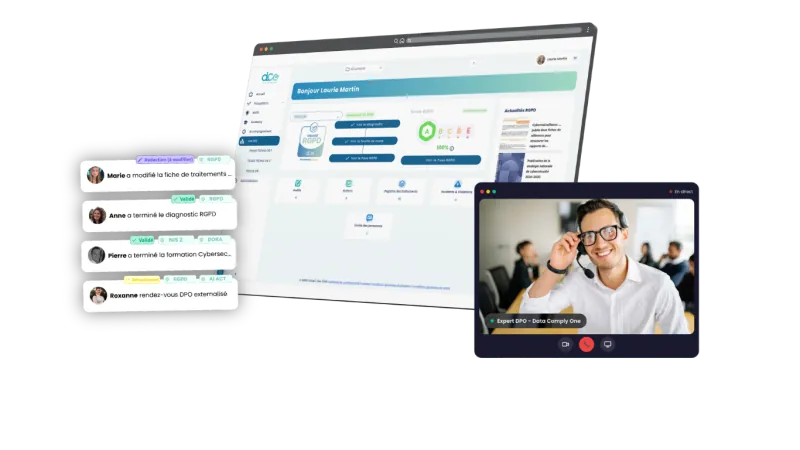
























































See Data Comply One in action
A single platform to steer your GDPR, NIS2, DORA, AI Act compliance, without juggling 10 tools.

Create your DCO workspace
Company detected
TECH & CIE
Want to test Data Comply One on your context?
By submitting this form, you agree that your data will be processed by Data Comply One to handle your request. To find out more, see our privacy policy.
The regulatory tsunami
is hitting your company.
7 major regulations, tightening deadlines and increasingly personal liability for executives.
2018
RGPD
Data protection
Deadline
In force
Fine
Up to 4% of revenue
2024
NIS2
EU cybersecurity
Deadline
Already in force
Fine
Up to 2% of revenue
2025
DORA
Digital resilience
Deadline
Already in force
Fine
Up to 1% of revenue / day
2025
AI Act
Artificial intelligence
Deadline
Already in force
Fine
Up to 7% of revenue
2025
Data Act
Data sharing
Deadline
Already in force
Fine
Up to 4% of revenue
2027
CRA
Cyber Resilience Act
Deadline
Dec 2027
Fine
Up to 2.5% of revenue
2027
GDPR 2.0
Ongoing revision
Deadline
In preparation
Fine
Being defined
Without structured steering, you expose yourself to:
Major legal risks
Executive personal liability
Damaged customer trust
Lost contracts
Not sure which regulations apply to you?
Get clarity in 30 seconds.
From regulatory chaos to managed serenity.
We've helped +1,000 organizations escape the chaos. Here's what concretely changes.
The regulatory chaos
Serene compliance
Too many regulations to handle in parallel
Unified multi-compliance steering (GDPR, NIS2, DORA, AI Act…)
Nobody in-house to drive compliance
Dedicated, experienced outsourced DPO & CISO
Legal stress & risk of fines
Clear, prioritized action plan and records always up-to-date in a few clicks
Executive personal liability at stake
Demonstrable compliance any time — downloadable Compliance Pass
Damaged customer trust, lost contracts
Official DCO label — a token of trust for your customers and partners
You can stack tools, mobilise consultants and trainers, and juggle multiple providers.
Or choose Data Comply One
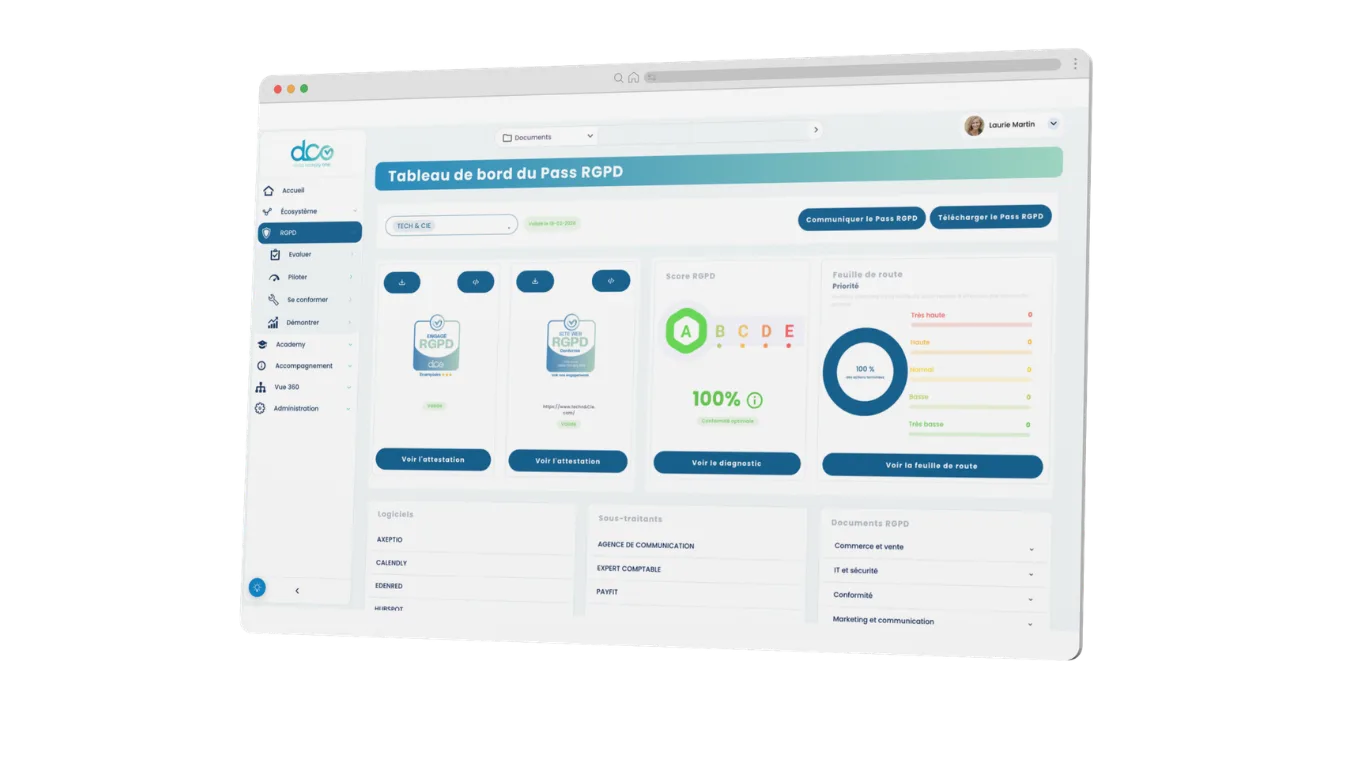 Platform
An ultra-simple compliance management platform
Centralise all your compliance in a single, intuitive tool. No more spreadsheets and scattered systems.
Discover An ultra-simple compliance management platform DPO/CISO Experts
Experts who take care of everything for you
Experienced, dedicated outsourced DPO and CISO. Entrust your compliance to them with complete peace of mind.
Discover Experts who take care of everything for you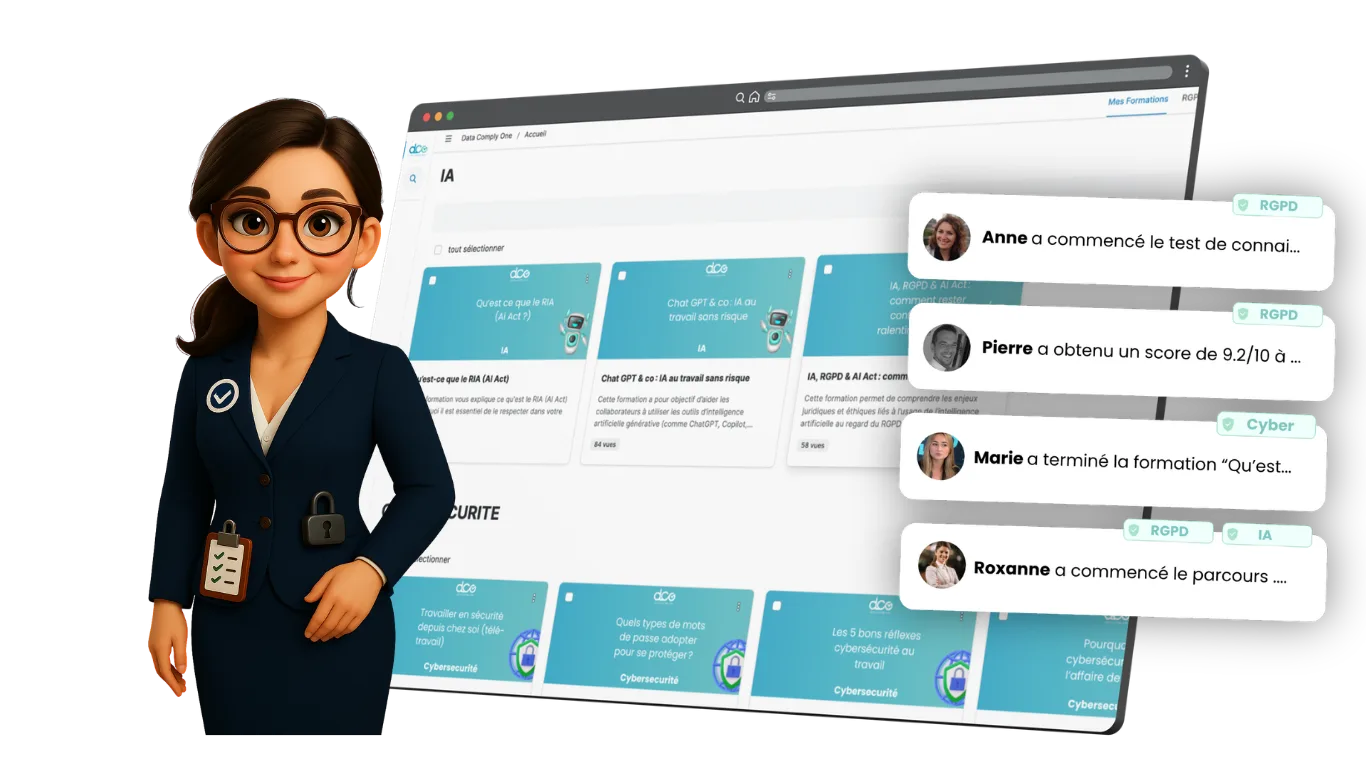 Academy
Engaging e-learning to train your teams
Raise your employees' awareness with short, engaging and multilingual training modules.
Discover Engaging e-learning to train your teamsYour compliance in 4 simple steps
A guided onboarding, a dedicated expert, a platform that adapts to your organisation.
Quote & account creation
Choose the right plan and access your personalised workspace in under 24 hours.
Guided configuration
A DCO expert sets up your platform according to your organisation and imports your existing data.
Diagnosis & implementation
Assess your compliance, get your score and follow your personalised roadmap.
Continuous management
Maintain compliance over time, handle operations and anticipate regulatory changes.
Move to all-in-one compliance with a single solution
One platform, every feature, all your compliance.
Compliance score
Real-time, clear and actionable assessment
Diagnosis & roadmap
Personalised, prioritised action plan
Automated registers
Processing and subprocessing in one click
Incidents & breaches
Compliant handling with complete tracking
Ecosystem & subprocessors
Continuous mapping and oversight
Compliance Pass
Centralised evidence ready for audits
GDPR Engaged label
Showcase your commitment to clients
Rights management
Automated workflow for data subject requests
Outsourced DPO / CISO
A dedicated expert by your side
E-learning GDPR · Cyber · AI
Short and engaging training modules
Concrete tangible results
from the very first months
Real-world benefits measured at our clients within the first months of using Data Comply One.
Up to
-0%
less time spent on compliance
Up to
+0%
more B2B contracts won through proven compliance
Up to
0%
optimal compliance & successful audits
Up to
0°
visibility on your risks & maturity
Why choose Data Comply One ?
A platform that combines what Excel, a standalone software or a consultant simply cannot offer.
They tell it better than we do
“Top-quality solution, very positive and constructive relationship with pragmatic teams. An outsourced DPO service combined with a SaaS tool to manage GDPR compliance.”
Xavier Guyader
Compliance Director · Groupe Avril

Groupe Avril
Agri-food industry
A team ofexperts by your side
DPOs, CISOs, AI lawyers and regulatory specialists: a multidisciplinary team supporting you across all European compliance frameworks.

● DPO live
GDPR compliance
● DPO live
AI Act compliance
● CISO live
NIS2 compliance
Every regulatory skill in a single team
A single point of contact, a team that scales with your needs: from regulatory monitoring to crisis management, we cover every dimension of European compliance.
DPO registered with supervisory authority
Outsourced CISO
AI lawyer
GDPR expert
NIS2 expert
AI Act expert
DORA expert
Data Act expert
Your sensitive data deserves a sovereign solution
Unlike US-based solutions, Data Comply One keeps your data under European jurisdiction and aligned with the highest security standards.

EU-based hosting · EU jurisdiction
100% European sovereignty
- Hosted in the EU by a certified European provider
- Your data remains under European jurisdiction (GDPR)
- No exposure to US CLOUD Act or FISA
Certified infrastructure
ISO 27001 & HDS hosting
- Data hosted on ISO 27001-certified infrastructure
- HDS-qualified hosting: cleared to host health data
- End-to-end encryption, daily backups
GDPR · AI Act · Data Act by design
Natively compliant solution
- Aligned with GDPR, AI Act and Data Act requirements
- Privacy & Compliance by design & by default across every module
- Regulatory monitoring built into the tool
Why does it matter?
A European solution truly protects you.
Solutions hosted in the United States (or owned by US groups) remain subject to the CLOUD Act and FISA: US authorities can demand access to your data, even when stored in Europe. Data Comply One removes that risk.
DCO- Data stored in the EU
- EU jurisdiction
- CLOUD Act: not concerned
- GDPR native
 US-based solutions
- Servers outside the EU
- US jurisdiction
- CLOUD Act applicable
- GDPR secondary
ISO 27001
Information security
HDS
Health Data Hosting
Test your compliance in 5 minutes
Instantly get an A to E score (Nutri-Score style) across all your European regulations, a personalised roadmap and the priority actions to take.
- 5-minute self-assessment
- A to E score (Nutri-Score style) per regulation
- Immediate prioritised action plan + PDF export
Instant result
GDPR
Self-diagnosis availablePersonal data protection
AI Act
Self-diagnosis availableEuropean regulation on artificial intelligence
NIS2
Self-diagnosis availableEuropean cybersecurity directive
Frequently asked questions
Everything you need to know about European regulatory compliance.
The General Data Protection Regulation (GDPR) is a European regulation that came into force on May 25, 2018. It applies to any organisation, public or private, that collects or processes personal data of European citizens, regardless of size or industry. Companies outside the EU are also concerned if they process data of European residents.
Turn burden into mastery.
Data Comply One turns your GDPR, AI and Cybersecurity compliance into a real competitive advantage. Join +1,000 companies and organizations who chose to manage compliance stress-free.
By submitting this form, you agree that your data will be processed by Data Comply One to handle your request. To find out more, see our privacy policy.